Tuesday, July 2, 2013

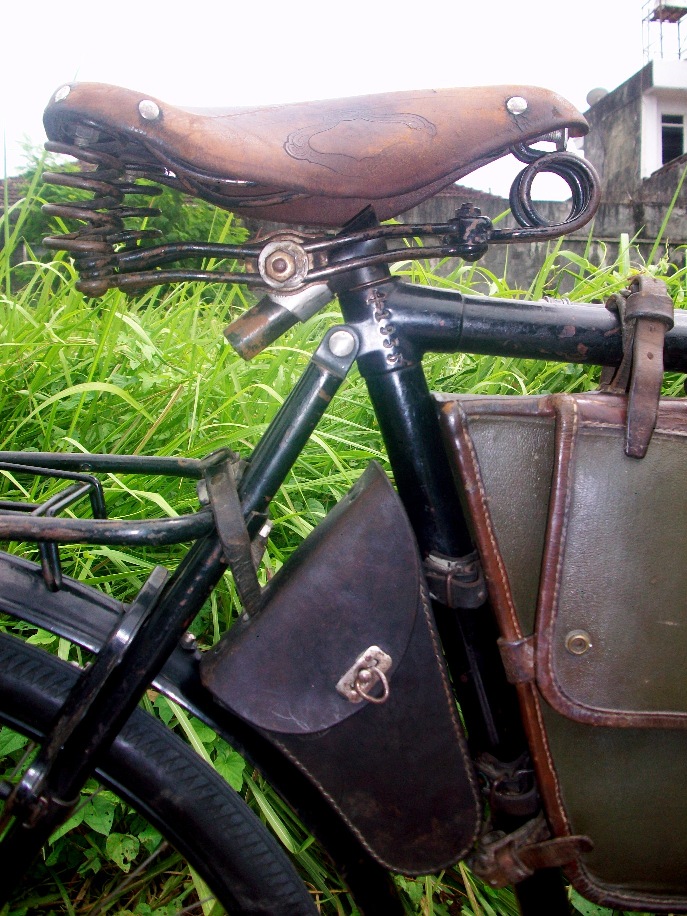
SWISS ARMY BICYCLE MO-05 VINTAGE (1945)
Swiss Army Bicycle MO-05 Vintage (1945).
Rugged and fine quality military bicycle
Tuesday, May 21, 2013
DIJUAL SEPEDA MILITER SWISS (SWISS ARMY)
DIJUAL sepeda Militer Swiss.
Photo-photo berikut adalah photo Army Bicycle - Condor MO-05. No rangka 13055, th 1935 (koleksi pribadi, tidak dijual).
Namun apabila Anda tertarik untuk memiliki sepeda sejenis, Condor MO 05, kami mempunyai 2 unit lagi produksi th 1928 dan 1946 yang akan kami jual.
Kondisi bagus dan masih orisinil.
Peminat silakan kontak:
Hp: 081905395030 atau 081364712699
Email: sepedaantikkita@gmail.com, thomasngh@gmail.com




BICYCLES AT WAR
By Elly Blue
 |
| Photo: Montague |
Two summers ago, I stood in the grass next to my bike, watching a tall,
muscly fellow demonstrate the moves he had been developing for self-defense
using a bicycle. He called it Bikendo. We practiced quickly raising our front
tires so the bikes stood vertically and we could use the wheels to keep
distance between ourselves and our imaginary assailants. Then, as our attackers
lunged at us, we stepped around the bikes and laid them on their backs, sending
the bad guys into a slow motion crotch-plant over the chainring. Ouch.
It turns out that bicycles can take down bigger threats than a shadowy
figure in a dark alley. “We perform well against the tanks,” explained one
Swiss soldier, vexed at the imminent dismantling of his bicycle-mounted
military unit.
But let me back up. Back in the 1880s, when two wheeled steeds with
pneumatic tires were state-of-the-art technology, the military saw their
usefulness in traveling quickly and silently over rugged terrain. Over the
years, armies worldwide, from Allied to Axis, adopted such innovations as
folding bicycles that could be conveniently strapped to your back or delivered
via parachute behind enemy lines. Bicycles eventually replaced horses, even as
they were in turn superseded by their motorized counterparts.
 |
|
Italian bicycle troops during World War I.
|
Switzerland’s bicycle regiment lasted the longest. Begun in 1891, it was
dismantled only a decade ago. This Bicycling
Magazine video from the 1980s shows the Swiss troops in action. One
soldier describes them as excellent for defending a small country — they’re
cheaper than heavier vehicles and can move undetected at relatively high speeds:
“At night, you can’t hear them.”
Bicycles were particularly effective because Switzerland is mountainous and
forested — a singletrack riders’ paradise, but perhaps not as copacetic for
maneuvering a tank or helicopter. And as any mountain bike enthusiast can
imagine, the Swiss bicycle brigade seems to have been particularly good for
morale.
The Swiss Army, though, hasn’t seen combat since World War II. Its sole
purpose is militia-style defense of the country’s borders. It was in response
to the 2001 news that the Swiss bicycle brigade would be abolished (it was
finally phased out in 2003), that the soldier complained:
“It is stupid. Over short distances we are very fast, much faster than the
motorized units. We can be very discreet, we are well armed and we perform well
against the tanks.”
Rumor has it, though, that the Dutch — already world-famous for their
embrace of the bicycle for all conceivable transportation purposes — may be
bringing bikes back into official military use. A photo in this slideshow
(brace yourself for the soundtrack) shows Dutch troops in Uruzgan province in
Afghanistan who have traded their armored vehicles for bicycles in
some patrols more in the spirit of community policing than combat — in order to
“make better contact with the population.” Dutch deployment in that country ended in late 2010 and with it, presumably, once
again the modern military use of bicycles.
As bicycles become more mainstream in U.S. cities, it stands to reason that
members of the military are embracing them in
their personal lives. Its obvious benefits in cost, health, and flexibility may
see bike transportation trickling back up into official operations.
The bicycle, though it’s increasingly branded with progressive politics, is
after all only a machine, and its possibilities are starting to be seen all
over again. New technologies, from carbon fiber to belt drives to electric
assists, may be the pneumatic tires of their day, and — it’s only for us
civilians to guess — may already be catching on as a new way to conduct ground
warfare.
Elly Blue is a writer and bicycle activist based in
Portland, Ore. She blogs at Taking the Lane and is writing a book about Bikenomics
that comes out in 2013. You can also find her on Twitter
U.S. ARMY'S 25th INFANTRY BICYCLE CORPS: WHELLS OF WAR
Originally published by American History magazine. Published Online: June 12, 2006
The
determined group of cyclists struggled against a stiff headwind as they pedaled
their fully loaded bicycles up the rocky road on a sticky, rainy day in June
1897. Forceful gusts whipped over the plains, punctuated by the sound of the
riders' labored breathing and the scrunching of tires along the dirt road. By
the time they reached their destination, the 23 riders–the U.S. Army's 25th
Infantry Bicycle Corps–would have traveled 1,900 miles.
Formed
in 1869, the 25th Infantry was one of four African-American military units
posted west of the Mississippi, serving as protectors and peacekeepers. The
25th was stationed on the Texas frontier until 1880, when it was transferred to
the Dakota Territory. Eight years later the unit moved to the hunting and
fishing paradise of Fort Missoula, Montana, from where the soldiers were
dispatched as peacekeeping forces during railroad and mine strikes and fought
forest fires in Montana and Idaho. Yet one of their most grueling tasks
involved cycling long distances under realistic field conditions.
Following
the advent of the chain-driven'safety' bicycle, developed in 1874 by H.J.
Lawson, and John Boyd Dunlop's 1888 pneumatic tire invention, cycling for
pleasure and for everyday transport became popular. Meanwhile, several European
armies had already established the bicycle's value for reconnaissance and
courier services.
The
U.S. Army, however, did not attempt any official experiments in bicycle
transport until 1896, when the task was assigned to the 25th Infantry. The
newly formed bicycle unit consisted of eight enlisted men and their white
commander, Lieutenant James A. Moss.
In
July 1896, the bicycle corps was given its first long-distance test, riding
north to Lake McDonald and back, a distance of 126 miles. During the three-day
expedition the soldiers encountered heavy rains, strong winds, deep mud, and
steep grades and suffered punctured tires, broken pedals, and loose rims and
chains. The corps gained valuable experience for the following month's test.
On
August 15, the riders pedaled out of Fort Missoula and reached Yellowstone Park
10 days and 500 miles later. There they rested and saw the sights for five days
before returning to their post. The soldiers averaged a speed of six miles per
hour over the steepest part of the route, more than twice that of infantrymen
traversing the same terrain.
The
summer of 1897 saw the bicycle corps undertake its longest, most challenging
test when its members set out for St. Louis. The chosen route closely followed
the Northern Pacific Railroad from the corps headquarters at Fort Missoula to
Billings, Montana. From there it paralleled the Burlington Northern Railroad
through Wyoming, South Dakota, Nebraska, and Missouri. Selected for its length,
difficult terrain, and extreme weather and road conditions, the route was
perfect for this military experiment.
The
unit's bicycles were the most modern available, built to military
specifications by A.G. Spalding & Bros. of Chicopee Falls, Massachusetts.
Eager for its product to undergo a rigorous service test, Spalding donated the
bicycles to the government. Although constructed with the most up-to-date
specifications, the bicycles had steel frames and rims and were cumbersome and heavy.
Each
rider carried a 10-pound blanket roll that included a shelter tent and poles, a
set of underwear, two pairs of socks, a handkerchief, and toothbrush and
powder. Properly packed, the roll fitted into a luggage carrier in front of the
bicycle's handlebars. Each man also carried rations of bacon, bread, canned
beef, baked beans, coffee, and sugar in hard leather cases attached to the
bicycle frame. Every other man carried a towel and a bar of soap, and each
squad chief carried a comb and brush and a box of matches. Fully loaded, the
soldiers' bicycles weighed about 59 pounds each. Every man also carried a
10-pound Krag-Jorgensen rifle and a 50-round cartridge belt.
Moss
chose 20 of the 40 infantrymen who volunteered for the expedition. The men
ranged in age from 24 to 39 and were in top physical condition. Five were
veterans of the previous year's trials. Moss described the corps as 'bubbling
over with enthusiasm . . . about as fine a looking and well disciplined a lot
as could be found anywhere in the United States Army.' Also joining the corps
were the assistant post surgeon, Dr. James M. Kennedy, and Edward Boos, a
reporter for the Daily Missoulian newspaper.
Corps
mechanic Private John Findley was an indispensable member of the unit,
responsible for keeping the bicycles in top running condition. Damaged front
crowns, front axles, pedals, and spokes would continually demand his mechanical
expertise and ingenuity.
The
cyclists pedaled out of Fort Missoula at 5:30 a.m. on June 14, 1897. When the
soldiers reached Missoula they rode through town in an impressive, double-file
formation as people lined the streets to cheer them on their way.
Unfortunately,
the bright start quickly dimmed as heavy rains turned the road to mud.
Lieutenant Moss noted in his official report that 'we rolled our wheels through
weeds and underbrush on the road side in order to avoid the mud, and then would
carry them a few paces and stop for second wind, as it were.' About 3:00 p.m.
the weather began to clear, and 'we stopped for an hour's rest, after which the
ride or rather the march was resumed over the muddy, hilly roads.' It was an
exhausting first day, but despite the wet weather the men managed to travel 54
miles.
Rain
fell in torrents through the night, and by morning the road was completely
impassable. Pushing off in a drizzling rain, the riders soon abandoned the road
and traveled along the Northern Pacific Railroad tracks. Instead of mud the
group endured bone-jarring jolts from mile after mile of railroad ties.
Near
noon on the fourth day the corps trekked across the Continental Divide,
enduring freezing temperatures and blowing sleet and snow that brought
visibility down to less than 20 feet. Every so often the cyclists stopped to
warm their hands and ears before pressing on. As they began their descent,
melting snow forced the men to peddle along in ankle-deep water.
The
soldiers were under pressure to make good time as they carried only two days'
rations. With food pick-up points stationed every 100 miles, their daily riding
average had to be 50 miles, although that wasn't always possible. Poor weather
conditions between the Crow Indian reservation and Fort Custer in south-central
Montana produced such muddy roads that the men covered only three miles in six
hours on the 10th day of their journey, and they ran out of food before the
next ration point. Boos wrote, 'We were wet, cold and hungry, and a more jaded
set of men never existed.'
On
the evening of June 25, the expedition reached the site of the Battle of the
Little Bighorn, fought exactly 21 years earlier. 'The site of our camp was on
the flat at the foot of the hill on which Gen. Custer fought the famous battle
and where the Indians pitched their lodges the day before the battle,' Boos
reported. Before eating their supper, the men 'visited the celebrated
battlefield and viewed the site of the massacre with interest. The writer went
over Custer's very line of march on his bicycle under the direction of Mr. A.N.
Grover, the custodian of the Custer National Cemetery.'
As
the corps traveled through Wyoming, South Dakota, and Nebraska, water became a
critical problem. The only potable supply came from railroad tanks, and if the
soldiers were too far from the railroad, they had no choice but to drink water
that was often alkali-tainted, causing sickness throughout the corps. Moss
reported that on June 29, after 'having ridden somewhat over twenty miles up an
almost continuous grade, under a broiling sun, we stopped, about 2 p.m. at
Gillette, Wyo., for lunch,' although many of the men were so tired that they
fell asleep while eating. After being advised that the next place where they
could obtain water was the town of Moorcroft, some 30 miles away, the corps
started on its way again. By 7:00 p.m. the men had covered about 16 miles and
'were bounding along at an eight-mile gait, when all at once the clouds began
to gather thick and fast, and almost immediately darkness was upon us.' Suddenly,
the front axle on one man's bicycle broke. Their need for water was too urgent
to stop for repairs, however, and the soldier had no choice but to push his
bicycle all the way to Moorcroft.
Moss
left Sergeant Mingo Sanders in temporary command while he pushed ahead with the
cook and two soldiers, 'intending to reach Moorcroft an hour or more before the
command and have supper ready as soon as they arrived.' Poor road conditions,
however, forced Moss and his men to dismount and push their bicycles. Darkness
descended before they reached town. 'While almost feeling our way along a road
wet and muddy from a rain from the previous day, we walked and walked and
walked, pushing our wheels before us,' noted Moss. 'The night air was damp,
chilly, and penetrating, and we were cold, hungry, and tired . . . I was really
sleeping on my feet.' After several hours of walking, the men were overcome by
sheer exhaustion. They collapsed on top of their tents, covered themselves with
their blankets, and fell asleep. When the four men awoke the next morning, they
saw the town of Moorcroft about a mile away.
The
soldiers regrouped and continued on through the southwest corner of South
Dakota, arriving in Crawford, Nebraska, on July 3 as the town's residents were
enjoying an early Independence Day celebration. Boos reported that 'The Fourth
of July celebration was at its height when the 25th U.S. Infantry Bicycle Corps
arrived at Crawford. The entire town was full of people and the corps was given
a hearty welcome . . . .'
As
the men continued east over the Nebraska plains in extreme heat, water problems
intensified. In one instance they rode 50 miles without water, their lips
parched and tongues swollen. Daytime temperatures were so high that the men
began their trek at daybreak and rode until mid-morning. They rested through
the hottest hours of the day and continued on in the late afternoon. If road
conditions were good, the corps frequently pedaled by moonlight.
About
nine miles out of Alliance, Nebraska, Lieutenant Moss was 'overcome from the
effects of alkali water, and taken back to town. For the next four days the
corps was under the command of Asst. Surgeon J.M. Kennedy.' Moss remained in
Alliance to recover, then rejoined the riders by train.
During
the four days under Dr. Kennedy's command, the soldiers endured some of the
highest temperatures of their journey. Making matters worse, their bicycles
sank eight to ten inches deep in Nebraska's Sand Hills, forcing the men once
again onto the railroad tracks, where they rumbled along for 170 miles. Moss
recalled that this distance was covered in four and a half days 'by almost
superhuman effort. On July 7 the thermometer registered 110 degrees in the
shade, and over half of the corps were sick . . . .' Fortunately, the journey was
nearing its end.
Twenty-three
miles west of St. Louis, newspaper reporter Henry Lucas camped with the bicycle
corps and prepared to escort the riders into the city. He relayed word to the St.
Louis Star that the men were in top physical condition, and their spirits
were high. He further reported, 'It is no uncommon sight for residents of this
city to see a company of wheelmen . . . but in today's visitors there is a
distinctiveness which will mark them at once as different from other riders . .
. . All belong to the African race except the Lieutenant.'
On
July 24 hundreds of St. Louis cyclists rode out to meet the approaching
regiment, and large crowds greeted the weary travelers as they made their way
into the city. During the next few days thousands of spectators visited the
corps' campsite and watched exhibition drills. The St. Louis Associated Cycling
Corps even sponsored a parade in honor of its military guests. This was 'the
most marvelous cycling trip in the history of the wheel and the most rapid military
march on record,' reported the St. Louis Star.
Moss
was particularly proud of his unit's persistence. 'There was no condition of
weather we did not endure, no topographical obstacle that we did not overcome,'
he told the St. Louis Post-Dispatch. In his official report, Moss
commended his men for the'spirit, pluck and fine soldierly qualities they
displayed.' He stressed that'some of our experiences, especially in the Sand
Hills of Nebraska, tested to the utmost not only their physical endurance, but
also their moral courage and disposition.'
The
trip lasted 40 days: 34 spent in travel and six used for rest and repairs. Due
to the extreme road and weather conditions, the men pushed their bicycles
nearly 400 of the total 1,900 miles traveled. Initially, the corps averaged 52
miles a day, but once the unit passed beyond the Sand Hills the rate increased
to 60 miles.
Moss
reported several problems that needed to be addressed, including the increase
of regulation rations, as provisions intended for two days lasted for only four
meals. He also recommended the addition of shock absorbers to the handlebars to
prevent jarring, as many men had suffered numbing pain from traveling over
rough roads and railroad tracks. In some places they had actually found it easier
to carry their fully loaded bicycles on their shoulders.
Nonetheless,
the experiment demonstrated that a bicycle corps could travel twice as fast as
cavalry and infantry under the same topographical conditions, at one-third the
cost. Moss remarked that a bicycle corps would be particularly useful in
situations that required speed rather than numbers, such as taking possession
of bridges or passes and holding them until reinforcements arrived. 'The
bicycle has a number of advantages over the horse,' Moss noted, 'it does not
require as much care, it needs no forage, it moves much faster over fair roads
. . . it is noiseless and raises but little dust, and it is impossible to
determine its direction from its tracks.' Still, Moss made it clear that he
didn't believe a bicycle corps could in any way take over the duties of mounted
cavalry. He maintained that the services complemented each other, and a bicycle
corps would best serve as adjuncts to both cavalry and infantry.
In
the end, the army decided not to establish a permanent bicycle corps. Lack of
good roads, the large supply of horses, and the country's vast expanse all
worked against the plan. After returning by train to their post at Fort
Missoula, the bicycle corps was disbanded as an active unit. Although several
different types of bicycles were developed for the army–including some models
that carried machine guns and repeating rifles–they failed to pass the
strenuous field tests. The arduous experience of the 25th Infantry Bicycle
Corps would never be repeated.
-
See more at:
http://www.historynet.com/us-armys-25th-infantry-bicycle-corps-wheels-of-war.htm#sthash.snMTd9GD.mRynHZl5.dpuf
Friday, April 5, 2013
BICYCLE TREE
The
Story:
A
boy left his bike chained to a tree when he went away to war in 1914. He never
returned, leaving the tree no choice but to grow around the bike. Incredible
that this bike has been there for 98 years now!

The
Fact:
In
1954 Helen Puz (who is now 99 years old) moved to Center with her five
children. At that time she had been recently widowed.
“People
were very sympathetic and generous,” writes Puz in a document on display at the
Vashon-Maury Island Heritage
Museum. “We were given a girl’s bike and my 8-year-old son, Don, seemed the
natural one to ride it.”
Don
was none too happy having a girls bike, said Puz, but it was better than none.
The
neighborhood boys, including Don, liked to play behind a local restaurant called,
“The Den.” (This restaurant is now called Sound Food.)
One
day Don told his mother that he had lost his bike and he wasn’t sure where he’d
left it. They both let it go because Don was a little embarrassed to be riding
a girl’s bike anyway.
Forty
years later Puz read in the Beachcomber, Vashon’s newspaper, that someone had
discovered a bike up in a tree near Sound Food. The bike was five feet off the
ground and the tree had grown around it. News of the tree bike even carried to
Japan where they made a film about it.
The
mystery of where Don Puz left his bike had finally been solved.
If
you’d like to see the bike in the tree, directions on how to get there can be
found at roadsideamerica.com.
(Resource: Heather Larson)
Thursday, April 4, 2013
BICYCLES IN COMMERCE AND WAR
 |
|
British bicycle troops in India, 1920s.
(c) Anthony Cox, http://www.blacktriangle.org
As the number of
bicycle riders increased among the general population in Europe and North
America, so did its application in commercial and military ways.
During WWI and WWII, armies from many nations fielded bicycle-mounted troops, and a passage from Ernest Hemingway's Farewell to Arms describes the main character's encounter with a unit of Germany Army soldiers on bikes:
"Look,
look!" Aymo said and pointed toward the road.
Along
the top of the stone bridge we could see German helmets moving. They were bent
forward and moved smoothly, almost supernaturally.
As
they came off the bridge, we saw them. They were bicycle troops. Their carbines
were clipped to the frame of the bicycles."
Over the 20th
century, bicycles have been adapted to haul heavy loads over long distances,
particularly in third-world countries, and even today in the world's crowded
cities, bike messagers and pedicabs play a valuable role in moving people and
packages in the most efficient means devised to date.
|
Subscribe to:
Posts (Atom)